Monday, 19 December 2016

Gold prices down in Asia on investor caution - Sean Seshadri

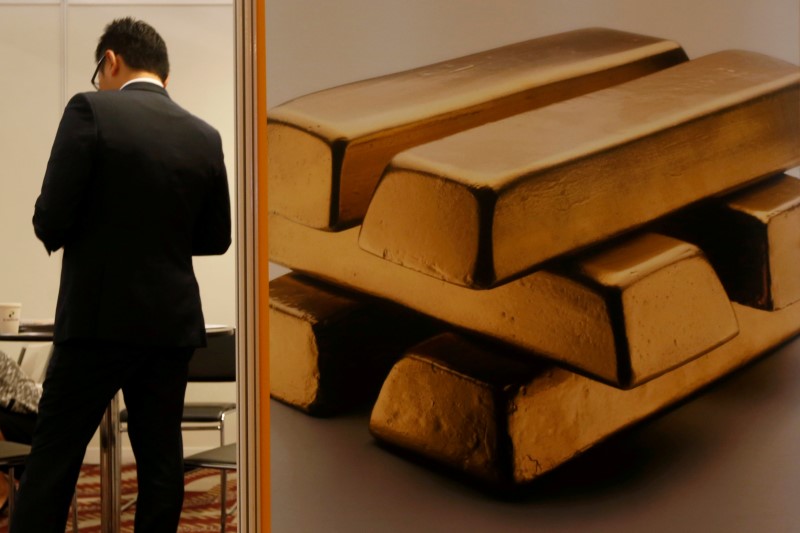
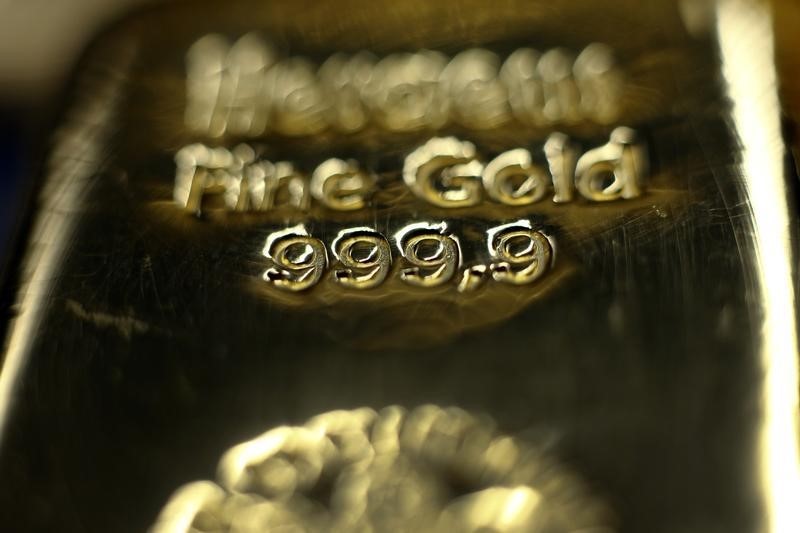
Gold prices fell in Asia as investors exercise caution on expectations of Fed rate hikes next year and a likely stronger dollar.
On the Comex division of the New York Mercantile Exchange, gold for January delivery fell 0.23% to $1,140.05 a troy ounce. Silver futures dipped 0.13% to $16.068 a troy ounce, while copper futures declined 0.24% to $2.496 a pound.

© Reuters.  Gold dips in Asia
On Tuesday as the Bank of Japan held steady as expected and signaled a slight uptick in the economy. Earlier, the Reserve Bank of Australia on Tuesday in the minutes of its latest board meeting said it is ready to lower the cash rate again, if needed, by assessing the benefits of lower interest rates with potential risks to household balance sheets.
Overnight, gold prices for February delivery settled lower on a stronger dollar and residual sentiment on an expected three Fed rate hikes in 2017. Fed Chair Janet Yellen on Monday said she sees wage growth picking up and a healthy job market for recent college graduates.
"While I expect workers will continue to face some challenges in the coming years, I believe, ... that the job prospects and career opportunities for new graduates at this time are very good," Yellen said in remarks prepared for the University of Baltimore's Midyear Commencement.
Yellen did not mention current monetary policy or other economic conditions in her remarks that focused on the current state of the job market facing the new graduates.

Sunday, 18 December 2016

Oil prices rise in anticipation of tighter 2017 market - Sean Seshadri

Oil prices rose on Monday in anticipation of tighter crude supply going into 2017 following the decision by OPEC and other producers to cut output to prop up prices.
Brent crude futures, the international benchmark for oil prices, were trading at $55.57 per barrel at 0401 GMT, up 36 cents, or 0.7 percent, from their last close.
U.S. West Texas Intermediate (WTI) crude oil futures were up 43 cents, or 0.8 percent, at $52.33 a barrel.
Traders said the higher prices in front-month crude futures were due to expectations of a tighter market.
The Organization of the Petroleum Exporting Countries (OPEC) and other producers led by Russia have announced cutbacks of almost 1.8 million barrels per day (bpd) in oil production from January 2017 in an effort to bolster prices to reduce rampant global overproduction which has seen output outstrip consumption for over two years.
© Reuters. An employee at a Total fuel station waits for customers in south Jakarta
"With investors now expecting a relatively high level of compliance with the production cut agreements, prices should be well supported," ANZ bank said on Monday.
"Saudi Arabia has stated its willingness to cut production below 10 million bpd if needed (down from around 10.5 million bpd currently), which should limit risk to the deal," U.S. bank Morgan Stanley (NYSE:MS) said on Monday, adding that some of the non-compliance risk to the deal to cut output in 2017 came from Iraq, which increased its January loadings versus December.
ANZ bank said that "some weakness in U.S. dollar also helped improve (oil) investor sentiment."
The dollar has lost 0.8 percent against a basket of other leading currencies since hitting 2002 highs last week.
Swings in the dollar can affect oil demand as they influence fuel prices for any country using its own currency domestically.
Despite this, there were factors that weighed on markets, preventing prices - which remain relatively low - from rising more.
In the United States, which did not participate in the production cut deal, drilling for new oil has increased for seven weeks.
Drillers added 12 oil rigs in the week to Dec. 16, bringing the total to 510, the highest since January, though still below 541 rigs a year ago, energy services firm Baker Hughes said on Friday.
"Since its trough on May 27, 2016, producers have added 194 oil rigs (+61 percent) in the U.S.," U.S. bank Goldman Sachs (NYSE:GS) said.
As a result, U.S. oil production is edging up, rising from below 8.5 million bpd in July to almost 8.8 million bpd by mid-December.

Thursday, 15 December 2016

Gold stages mild rebound in Asia on price dips post Fed hike - Sean Seshadri

Gold prices gained in Asia on Friday in rebound trade from recent lows, though the downbeat trend remains in track on a stronger dollar and growing appetite for riskier investments.
On the Comex division of the New York Mercantile Exchange gold futures for February delivery rose 0.28% to $1,132.95 a troy ounce. Silver futures on the Comex jumped 0.76% to $16.080 a troy ounce. Copper futures rose 0.15% to $2.601 a pound.
© Reuters.  Gold rebounds in Asia
Overnight, gold prices fell to the lowest settlement price in 10 months as investors head for risk-on assets over safe-haven holdings such as the precious metal.
A global sell-off in gold exchange-traded funds and weak physical markets in China and India are taking away price momentum.
Indian demand, meantime, has suffered from a liquidity crisis in recent weeks as a massive swap of currency notes is underway that has dried up liqudity in the cash-intensive economy which view with China as the top importer of gold.

Tuesday, 13 December 2016

Oil prices fall on rising U.S. crude stocks, OPEC output concerns - Sean Seshadri

Oil prices fell on Wednesday following a reported rise in U.S. crude inventories and an estimate that OPEC may have produced more crude in November than previously thought, potentially undermining a planned output cut.
U.S. West Texas Intermediate (WTI) crude oil futures were down 69 cents, or 1.3 percent, to $52.29 a barrel at 0430 GMT.
International Brent crude futures were down 69 cents, or 1.2 percent, at $55.03 per barrel.
Traders said the price falls followed a report of surprise increases in U.S. crude inventories. Markets were also focused on an anticipated U.S. interest rate hike, likely supporting the dollar and making dollar-traded fuel imports more expensive for countries using other currencies at home.
© Reuters. An oil well pump jack is seen at an oil field supply yard near Denver
"Momentum continues to wane in oil markets with both Brent and WTI slightly lower overnight, following higher than expected API inventory numbers in the United States ... (which) showed an unexpectedly large increase of 4.7 million barrels," said Jeffrey Halley, senior market analyst at OANDA brokerage in Singapore.
"We expect Asia trading to have a slightly negative bias as traders trim longs into the Federal Reserves' main event this evening," he added, referring to the expected decision later on Wednesday by the U.S. central bank to hike interest rates.
Greg McKenna, chief market strategist foreign exchange and futures brokerage AxiTrader said that "traders pretty much have a Fed increase of 25 basis points locked and loaded."
Oil traders said prices were further depressed by a report from the International Energy Agency (IEA) which said it believes that Middle East producer club OPEC pumped about 34.2 million barrels a day of crude in November, 500,000 bpd above OPEC's official estimate, which was already a record.
If correct, that would undermine the effort by the Organization of the Petroleum Exporting Countries (OPEC) and non-OPEC producers like Russia to cut almost 1.8 million bpd of production in a bid to end two years of oversupply and cheap oil.
The agency said global oil supply rose to a record 98.2 million bpd in November, as OPEC production offset declines elsewhere.
This stands against expectations of 96.95 million bpd of global oil demand for the fourth quarter of 2016.
Despite this, the IEA said that due to firm demand increases, oil market could show a shortfall of 600,000 bpd early next year if producers stick to their reduction plans.

Wednesday, 7 December 2016

Oil prices rise on U.S. crude stock decline, weaker dollar - Sean Seshadri

* U.S. crude inventories fall by 2.4 mln barrels last week -EIA
* Questions linger on producers can keep to output deal
By Jane Chung
SEOUL, Dec 8 (Reuters) - Oil prices edged up on Thursday, supported by a weaker dollar ahead of next week's Federal Reserve meeting and by a drawdown in U.S. crude stocks.
International Brent LCOc1 crude futures were trading up 18 cents, or 0.34 percent, at $53.18 a barrel at 0116 GMT.
U.S. benchmark West Texas Intermediate crude oil prices CLc1 edged up 29 cents, or 0.58 percent to $50.06 a barrel.
© Reuters.  Oil prices rise on U.S. crude stock decline, weaker dollar
Crude oil inventories in the United States dropped 2.4 million barrels in the week that ended on Dec. 2, compared with analyst expectations for a draw of 1 million barrels.
But stocks at the Cushing, Oklahoma, delivery hub for U.S. crude futures, increased by a hefty 3.8 million barrels last week, the most since 2009, according to data from the U.S. Energy Information Administration on Wednesday. prices have been supported since the Organization of Petroleum Exporting Countries (OPEC) and Russia reached a landmark agreement last week to cut production to erode a global supply overhang and prop up prices.
The U.S. dollar index .DOXY fell as Treasury bond yields eased and as investors eye next week's Fed meeting. A weak dollar makes dollar-denominated oil less expensive for importing countries. doubts remain over whether OPEC will be able to comply with output cuts and whether those curbs will be enough to rebalance markets.
OPEC and non-OPEC oil producers will meet again this weekend in Austria's capital to discuss the details of last week's agreement, which aims at an overall reduction in output of around 1.5 million barrels a day.

Oil slips on doubts output cut will end global glut - Sean Seshadri

Oil prices slipped on Wednesday on doubts that promised production cuts by OPEC and Russia would be deep enough to end a supply overhang that has weighed on the markets for more than two years.
North Sea Brent crude (LCOc1) was down 30 cents a barrel at $53.63 by 0840 GMT. U.S. light crude (CLc1) was down 35 cents at $50.58 a barrel.
Oil prices surged as much as 19 percent after the Organization of the Petroleum Exporting Countries and Russia announced last week that they would cut production next year in an effort to prop up markets.
But doubts have emerged over whether the planned cuts will be big enough to rebalance the market.
Since the deal was announced, both OPEC and Russia have reported record production and output elsewhere is also resilient.
© Reuters. A pump jack is seen at sunrise near Bakersfield
The U.S. Energy Information Administration said on Tuesday it expected domestic crude oil production for 2016 and 2017 to fall by less than previously expected.
"Investors are torn between hopes that producers will cut enough production to balance supply and demand, and fears that they won't," said Tamas Varga, senior analyst at London brokerage PVM Oil Associates.
OPEC and non-OPEC oil producers meet this weekend in Vienna to agree details of the output cut, which targets an overall reduction of around 1.5 million barrels per day (bpd).
OPEC member Nigeria, exempt from the cuts, said on Wednesday it hoped to boost its oil production to 2.1 million bpd in January, up from 1.9 million bpd now.
"We will see whether belief in the (OPEC production) deal will hold," said Eugen Weinberg, head of commodities research at Commerzbank (DE:CBKG) in Frankfurt. "There is a big discrepancy right now between expectations, perception and reality."
Despite widespread scepticism, many analysts say 2017 will likely see a more balanced oil market.
"Oil markets are on track to tighten over 2017, which will be accelerated by OPEC's decision to reduce production alongside non-OPEC countries," said BMI Research. "If effectively implemented, we expect the global oil market will return to balance in Q1 2017."
Oil production has been outpacing consumption by 1 to 2 million barrels per day since late 2014.
As a result of a more balanced market next year, BMI said that "the average annual oil price will be higher in 2017 than in 2016, with Brent at $55 per barrel for the year". The average 2016 Brent price has so far been $44.47 per barrel.

Monday, 5 December 2016

Gold prices dip in Asia after early bargain hunting, Fed views eyed - Sean Seshadri

Gold eased on Tuesday in Asia after an early round of bargain hunting as investors look beyond the widely expected Fed rate hike this month for any new language on the pace of increases going forward.
On the Comex division of the New York Mercantile Exchange gold fell 0.07% to $1,175.65 a troy ounce. Elsewhere in metals trading, silver for March delivery on the Comex rose 0.08% to $16.913 a troy ounce, while copper for March delivery fell 0.45% to $2.682 a pound.
Overnight, gold prices fell more than 1% on Monday as strength in equity markets hit safe haven demand for the precious metal and as expectations for a U.S. rate hike this month continued to weigh.
Gold initially gained after Italian voters rejected a referendum on constitutional changes backed by the government, prompting Prime Minister Matteo Renzi to step down and sending the euro to 20-month lows.
© Reuters.  Gold dips in Asia
But European stock markets and the single currency rebounded as the referendum outcome had been largely priced in by markets.
Investors were also reassured after the European Central Bank said last week that it was prepared to temporarily step up purchases of Italian government bonds should the referendum results drive up borrowing costs.
Stronger risk appetite curbs the appeal of traditional safe-haven assets, such as gold.
A report from the Institute of Supply Management on Monday showed that gauge of non-manufacturing activity hit a one-year high in November, adding to optimism over the economic outlook.
The precious metal fell almost 8% in November on the back of expectations that increased U.S. fiscal spending under a Trump administration will spur economic growth and inflation, which would ultimately lead to an era of higher interest rates.
Expectations of tighter monetary policy tend to weigh on gold, which struggles to compete with yield-bearing assets when borrowing costs rise. Overnight, New York Fed President William Dudley said on Monday it was too soon for the Fed to judge whether its plan for gradual interest rate hikes needed adjusting under a Trump administration.

Sunday, 4 December 2016

Oil prices fall as production creeps up ahead of announced 2017 output cut - Sean Seshadri

Oil prices fell by one percent on Monday as a higher U.S. rig count unsettled markets amid nagging concern that output cuts, planned as part of concerted action between producer club OPEC and Russia, might not be as big as initially anticipated.
Brent crude futures were trading at $53.89 per barrel at 0132 GMT, down 57 cents, or over 1 percent, from their last close.
West Texas Intermediate (WTI) crude futures were at $51.49 a barrel, down 52 cents, or 1 percent.
Traders said price falls were triggered by rising production just after last week's accord between the Organization of the Petroleum Exporting Countries (OPEC) and non-OPEC member Russia to cut output in 2017. The cuts aim to rein in a supply glut that has weighed on markets for over two years.
© Reuters. Rigging equipment is pictured in a field outside of Sweetwater Texas
(For graphic on OPEC's market share struggle, click http://tmsnrt.rs/2cWq5NN)
Meanwhile U.S. energy firms extended drilling for new oil production into a seventh month last week, data from energy services firm Baker Hughes showed on Friday. .
"The U.S. oil rig count continued its rally this week, up by 3 rigs...Since its trough on May 27, 2016, producers have added 161 oil rigs (+51 percent) in the U.S.," Goldman Sachs (NYSE:GS) said.
Overall - accounting for the recent rise in oil drilling, but also for cutbacks earlier this year on low prices - Goldman said "year-on-year production will decline by 620,000 barrels per day (bpd) in 2016 and increase by 55,000 bpd in 2017".
With U.S. production set to edge up, there are also gnawing concerns that the cuts announced last week by OPEC and Russia might not be as deep as initially anticipated. The planned reductions brought the sharpest weekly crude price rises in years.
Russia on Friday reported average daily oil production of 11.21 million bpd for November - its highest in almost 30 years.
And while Moscow has agreed to cut its output by 300,000 bpd in early 2017, it said it would do so against November levels. That means that even after a reduction, its output would remain higher than it was at the peak of the oil glut in the first half of 2016.
Jeffrey Halley of brokerage OANDA in Singapore said oil traders were "nervous (as) Russia's output has hit record levels, meaning their part of the production cut takes them back to what they were producing only quite recently".
In the Middle East, where the deepest OPEC production cuts are expected, there are also signs that production will rise before it gets cut.
Saudi Arabia and Kuwait are expected to agree this month to resume oil production, with a potential of 300,000 barrels in daily output, from jointly operated oilfields which were shut down between 2014 and 2015 for environmental and technical difficulties.

Thursday, 1 December 2016

Gold prices down in Asia as U.S. jobs data awaited - Sean Seshadri

Gold prices fell in Asia on Friday ahead of U.S. jobs data that is seen as icing on the cake for a Fed rate hike this month.
Nonfarm payrolls are seen up by 175,000 in November, deemed enough by most analysts to assure the Fed that the labor market continues to tighten, adding pressure on wages.
Gold futures for February on the Comex division of the New York Mercantile Exchange rose 0.57% to $1,176.05 a troy ounce. Silver futures on the Comex gained 0.80% to $16.638 a troy ounce, while copper futures dropped 0.72% to $2.616 a pound.
© Reuters.  Gold down in Asia
Overnight, gold price fell after the release of upbeat U.S. manufacturing activity data offset more disappointing U.S. jobless claims report.
The Institute for Supply Management said its manufacturing activity index rose to 53.2 last month from October’s reading of 51.9. Analysts had forecast a smaller increase to 52.2.
The report came after the U.S. Department of Labor said that initial jobless claims in the week ending November 26 increased by 17,000 to 268,000 from the previous week’s total of 251,000. Analysts had expected jobless claims to rise by just 2,000 to 253,000 last week.
The data made the case that the Federal Reserve will take a more aggressive approach on monetary policy this month. The Fed has been loathe to raise interest rates, during the Obama administration, because of tepid economic performance during the "recovery" from the Great Recession of 2007. U.S.
Market anticipation of so-called "tighter" monetary policy weighs heavily on gold, which competes with yield-bearing bonds and other instruments whenever borrowing costs rise.