Tuesday, 25 July 2017

Oil prices firm on optimism over declining stocks - Sean Seshadri

Oil prices firmed on Wednesday to hold near eight-week highs hit in the previous session, on expectations of a drawdown in U.S. stocks and as a rise in shale oil production shows signs of slowing.
Brent crude futures had risen 36 cents, or 0.7 percent, to $50.56 a barrel by 0332 GMT, after rallying more than 3 percent on Tuesday.
U.S. West Texas Intermediate futures climbed 46 cents, or 1 percent, to $48.35 a barrel.
U.S. crude stocks fell sharply last week as refineries boosted output, while gasoline inventories increased and distillate stocks decreased, data from industry group the American Petroleum Institute showed on Tuesday.

© Reuters. An employee pumps petrol for clients at a petrol station in Hanoi
Crude inventories declined by 10.2 million barrels in the week ending July 21 to 487 million, compared with expectations for a decrease of 2.6 million barrels.
The market has been buoyed by Saudi Arabia's announcement at a meeting of the Organization of the Petroleum Exporting Countries (OPEC) and non-OPEC producers on Monday that it would limit crude exports to 6.6 million barrels per day (bpd) in August, down nearly 1 million bpd from a year earlier.
"This has seen expectations of further drawdown in inventories increase," ANZ said in a research note, referring to the Saudi plans.
Nigeria also agreed to join a push to rein in production by capping or cutting its output from 1.8 million bpd once it stabilizes at that level.
However, the current uptrend in oil prices could be limited to the low $50 per barrel region, according to Ric Spooner, chief market analyst at CMC Markets in Sydney.
"As we approach $50 and into the low $50s, that's a level that could attract increased U.S. shale oil production if it stays around that level," he said.
On Monday, Anadarko Petroleum Corp (NYSE:APC) said it would cut its 2017 capital budget by $300 million because of depressed oil prices, the first major U.S. oil producer to do so, after posting a larger-than-expected quarterly loss.
Oil prices have come under pressure from an oversupply of crude around the globe, brought on in part by rising production from U.S. shale regions.
Indonesia's energy minister said on Tuesday that Southeast Asia's top crude producer would be open to rejoining the Organization of the Petroleum Exporting Countries (OPEC) as long as it is not forced to curb its own crude oil production.

Australia stocks higher at close of trade; S&P/ASX 200 up 0.87% - Sean Seshadri

Australia stocks were higher after the close on Wednesday, as gains in the EnergyResources and Metals & Mining sectors led shares higher.
At the close in Sydney, the S&P/ASX 200 gained 0.87%.
The best performers of the session on the S&P/ASX 200 were OZ Minerals Ltd (AX:OZL), which rose 10.79% or 0.795 points to trade at 8.165 at the close. Meanwhile, Seven Group Holdings Ltd (AX:SVW) added 10.77% or 1.110 points to end at 11.420 and Sigma Pharmaceuticals Ltd (AX:SIG) was up 9.30% or 0.080 points to 0.940 in late trade.
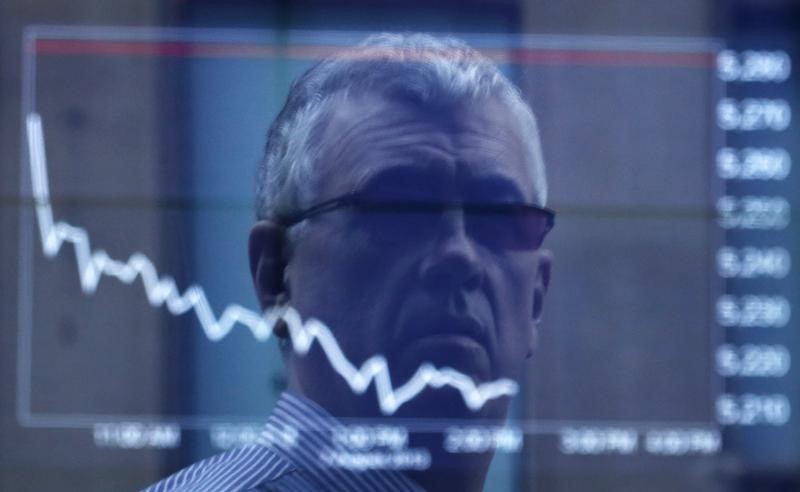
© Reuters.  Australia stocks higher at close of trade; S&P/ASX 200 up 0.87%
The worst performers of the session were Domino'S Pizza Enterprises Ltd (AX:DMP), which fell 4.66% or 2.700 points to trade at 55.300 at the close. Independence Group NL (AX:IGO) declined 3.34% or 0.110 points to end at 3.180 and Aristocrat Leisure Ltd (AX:ALL) was down 3.11% or 0.650 points to 20.260.
Rising stocks outnumbered declining ones on the Sydney Stock Exchange by 656 to 489 and 352 ended unchanged.
The S&P/ASX 200 VIX, which measures the implied volatility of S&P/ASX 200 options, was down 2.86% to 12.414.
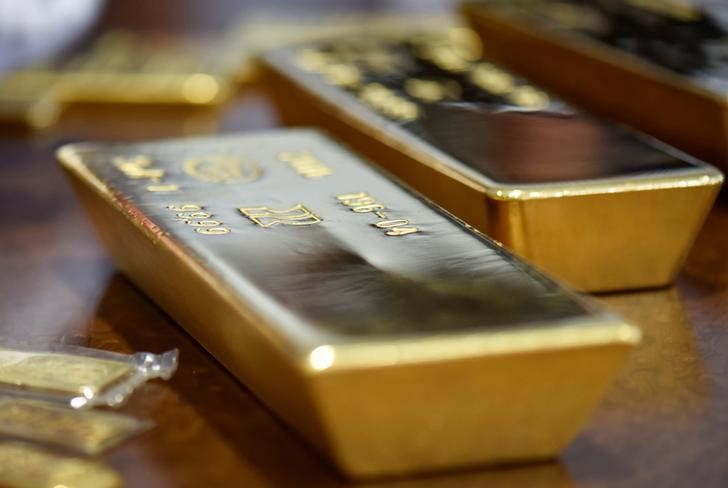
Gold Futures for August delivery was down 0.50% or 6.21 to $1245.89 a troy ounce. Elsewhere in commodities trading, Crude oil for delivery in September rose 0.98% or 0.47 to hit $48.36 a barrel, while the September Brent oil contract rose 0.78% or 0.39 to trade at $50.59 a barrel.
AUD/USD was down 0.58% to 0.7890, while AUD/JPY fell 0.59% to 88.29.
The US Dollar Index Futures was up 0.05% at 93.97.

Sean Seshadri - Gold holds near 1-month high ahead of Fed meeting

Gold prices held near their highest level in around a month in European trade on Tuesday, as market players looked ahead to a Federal Reserve policy meeting for any new insight on the timing of the next U.S. rate hike and clues on how the central bank plans to pare back its balance sheet.
Comex gold futures were at $1,256.73 a troy ounce by 3:15AM ET (0715GMT), up $2.60, or about 0.2%. It touched its highest since June 26 at $1,259.00 in the prior session.
Gold prices finished a few cents lower on Monday, ending a six-session win streak.
The Fed is not expected to take action on interest rates at the conclusion of its two-day policy meeting on Wednesday, keeping it in a range between 1.0%-1.25%.
© Reuters.  Gold holds near highest in a month ahead of Fed
The central bank will release its post-meeting statement as investors look for any change in language which could point more clearly to a rate hike in the months ahead.
Market players will also pay close attention to details of when and how the Fed will start reducing its $4.5 trillion balance sheet.
According to Investing.com’s Fed Rate Monitor Tool, conviction for another rate hike before the end of the year has faded, with just 35% of market players expecting another move by December, as the subdued inflation outlook raised doubts over whether policymakers will be able to stick to their planned tightening path.
The precious metal is sensitive to moves in U.S. rates, which lift the opportunity cost of holding non-yielding assets such as bullion.
Focus will also be on headlines coming out of Washington, where the Senate is expected to continue working to repeal Obamacare. The investigation into U.S. President Donald Trump campaign's ties to Russia will continue to get attention.
Gold has been well-supported in recent sessions as ongoing political turmoil in the White House and weakness in the U.S. dollar spurred haven demand for the precious metal.
Elsewhere on the Comex, silver futures inched up 4.0 cents, or roughly 0.2%, to $16.48 a troy ounce, after hitting a three-week high of $16.57 a day earlier.
Among other precious metals, platinum was up 0.6% at $937.65, while palladium added 0.6% to $854.15 an ounce.

Sean Seshadri - Oil rises for second day in a row on OPEC support pledges

Oil prices continued higher in European trade on Tuesday, extending gains into a second session after OPEC producers pledged further support measures to help speed the rebalancing of global supply and demand.
The U.S. West Texas Intermediate crude September contract was at $46.62 a barrel by 3:40AM ET (0740GMT), up 28 cents, or around 0.6%.
Elsewhere, Brent oil for September delivery on the ICE Futures Exchange in London tacked on 26 cents to $48.87 a barrel.
Oil prices finished higher on Monday after Saudi Arabia pledged to make deep cuts to its crude exports in August.
Saudi Arabia, OPEC’s largest producer, will limit exports to 6.6 million barrels a day in August, energy minister Khalid Al-Falih said after a meeting with fellow crude producers on Monday.
© Reuters.  Oil rises for second day in a row on OPEC support pledges
Meanwhile, Nigeria, which has been exempt from this year’s OPEC-led production-cut deal, pledged to take part in cuts once it reaches a production level of 1.8 million barrels a day. The cartel’s latest data put the country’s output at around 1.7 million.
In May, OPEC and some non-OPEC producers, such as Russia, extended an agreement to slash 1.8 million barrels per day in supply until March 2018.
So far, the agreement has had little impact on global inventory levels due to rising supply from producers not participating in the accord, such as Libya and Nigeria, as well as a relentless increase in U.S. shale production.
Investors now looked ahead to weekly data from the U.S. on stockpiles of crude and refined products.

Industry group the American Petroleum Institute is due to release its weekly report at 4:30PM ET (2030GMT) later on Tuesday. Official data from the Energy Information Administration will be released Wednesday, amid forecasts for an oil-stock drop of around 3.0 million barrels.
Elsewhere on Nymex, gasoline futures for August was little changed at $1.559 a gallon, while August heating oil added half a cent to $1.522 a gallon.
Natural gas futures for September delivery ticked up 2.0 cents to $2.902 per million British thermal units.

Thursday, 13 July 2017

Sean Seshadri - IEA says OPEC compliance with oil cuts at lowest in six months

OPEC's compliance with production cuts fell in June to its lowest levels in six months as several members pumped much more oil than allowed by their supply deal, thus delaying market rebalancing, the International Energy Agency said on Thursday.
OPEC's compliance with cuts slumped to 78 percent last month from 95 percent in May as higher-than-allowed output from Algeria, Ecuador, Gabon, Iraq, the UAE and Venezuela offset strong compliance from Saudi Arabia, Kuwait, Qatar and Angola.
"Each month something seems to come along to raise doubts about the pace of the rebalancing process. This month, there are two hitches: a dramatic recovery in oil production from Libya and Nigeria and a lower rate of compliance by OPEC with its own output agreement," the Paris-based IEA said.
IEA says OPEC compliance with oil cuts at lowest in six months
The Organization of the Petroleum Exporting Countries and several non-OPEC producers including Russia have agreed to cut production by around 1.8 million barrels per day until March 2018 to ease a global crude glut spurred by booming U.S. output.
OPEC members Libya and Nigeria were exempted from the cuts due to years of unrest that have sapped their output. The two countries have managed to increase their combined production by more than 700,000 bpd in recent months, the IEA said.
"For fellow OPEC members, who agreed to reduce production by 1.2 million bpd, to see their cut effectively diluted by nearly two-thirds must be very frustrating, especially as their pact has, hitherto, been well observed by historical standards," the IEA said.
The cuts have stabilized oil at around $45-50 per barrel, but prices have come under renewed pressure in recent weeks due to growing U.S. output and little evidence of global stocks falling from record highs above 3 billion barrels.
The IEA, which advises industrialized nations on energy policy, said strong demand growth in the second half of 2017 and in 2018 should nevertheless speed up market rebalancing.
It said demand for OPEC's crude was forecast to rise steadily through 2017 and reach 33.6 million bpd in the fourth quarter - up 1 million bpd on OPEC's June output.
"Provided there is strong compliance with OPEC's cuts, that would imply a hefty stock draw, even if Libya and Nigeria recover further," it said.
The IEA said stocks in industrialized nations in May were 266 million barrels above the five-year average, down from 300 million barrels in April. Preliminary data shows a further moderate reduction in stocks for June.
The agency also said that while non-OPEC producers such as the United States, Canada and Brazil were firmly back in growth mode, the recent decline in oil prices could force some U.S. producers to reassess their prospects.
"Financial data suggests that while output might be gushing, profits are not and recent press reports quoted leading company executives saying that oil prices need to be around $50 per barrel to maintain production growth," the IEA said.

Wednesday, 12 July 2017

Oil posts solid gains ahead of U.S. supply update - Sean Seshadri

Oil prices were higher in North American trade on Wednesday, extending gains into a third-straight session, as investors looked ahead to weekly data from the U.S. on stockpiles of crude and refined products later in the global day.
The U.S. West Texas Intermediate crude August contract was at $45.88 a barrel by 3:35AM ET (0735GMT), up 82 cents, or around 1.8%.
Elsewhere, Brent oil for September delivery on the ICE Futures Exchange in London climbed 75 cents to $48.29 a barrel.
The U.S. Energy Information Administration will release its official weekly oil supplies report at 10:30AM ET (1430GMT).
© Reuters.  Oil jumps ahead of U.S. supply update
Analysts expect crude oil inventories dropped by around 2.8 million barrels at the end of last week, while gasoline supplies are seen increasing by 1.1 million barrels and distillates are forecast to gain about 1.3 million barrels.
After markets closed Tuesday, the American Petroleum Institute said that U.S. oil inventories fell by 8.1 million barrels in the week ended July 7.
The API report also showed a decline of 800,000 barrels in gasoline stocks, while distillate stocks rose by 2.1 million barrels.
There are often sharp divergences between the API estimates and the official figures from EIA.
Oil ended higher on Tuesday, rising about 1.4%, as a lower 2018 forecast on U.S. crude production and speculation of possible output curbs in Libya and Nigeria fueled the strongest session gain for prices in over a week.
The two countries had been exempted from the pact among major oil producers, led by the Organization of the Petroleum Exporting Countries, to limit global production and ease a glut of oil that has plagued the industry.
OPEC will release its monthly oil report later in the day, which includes figures on the state of global crude stockpiles. The data will give traders a better picture of whether a global rebalancing is taking place in the oil market.
Elsewhere on Nymex, gasoline futures for August was little changed at $1.533 a gallon, while August heating oil added 1.8 cents to $1.494 a gallon.
Natural gas futures for August delivery slipped 2.3 cents to $3.024 per million British thermal units.

Tuesday, 11 July 2017

Oil falls as banks cut price forecasts - Sean Seshadri

Oil prices fell on Tuesday as global oversupply encouraged several banks cut their price forecasts.
Benchmark Brent crude (LCOc1) was down 30 cents at $46.58 a barrel by 0945 GMT. U.S. crude (CLc1) was 25 cents lower at $44.15.
"The fundamental mood has taken a turn for the worse," Harry Tchilinguirian, head of oil strategy at French bank BNP Paribas (PA:BNPP), told Reuters Global Oil Forum.
He said BNP Paribas had slashed its forecasts for Brent by $9 to $51 a barrel for 2017 and by $15 to $48 for 2018.
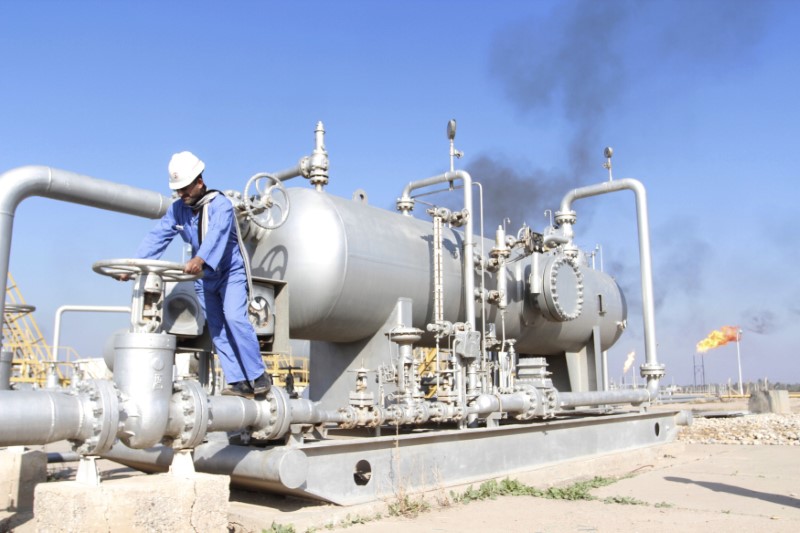
© Reuters. FILE PHOTO: A worker checks the valve of an oil pipe at Nahr Bin Umar oil field north of Basra
Barclays (LON:BARC) bank also cut its 2017 and 2018 Brent forecasts to $52 a barrel for both years from $55 and $57 respectively.
Signs of strong short-term demand helped stem losses.
Gasoline demand tends to increase in the northern hemisphere summer as U.S. drivers take to the road.
Weekly U.S. gasoline demand data "compares favorably to the five-year average and miles driven also continue to grow year-on-year," Bank of America Merrill Lynch (NYSE:BAC) said in a note.
But it also said: "U.S. gasoline demand may have peaked in absolute terms last year," adding that it expected no structural tightness once the peak demand summer season was over.
Crude prices are about 18 percent below their 2017 opening levels despite a deal led by the Organization of the Petroleum Exporting Countries to cut production from January.
OPEC, along with Russia and some other major exporters, has agreed to hold production at about 1.8 million barrels per day (bpd) below levels pumped at the end of last year.
The limits will be maintained until March 2018 in an attempt to drain a global glut, but production elsewhere has risen as OPEC has held back.
U.S. oil production has jumped more than 10 percent over the last year to 9.34 million bpd. Nigeria and Libya, OPEC-members who are exempt from production limits, have also increased output.
"OPEC has yet to address this increase in production," Goldman Sachs (NYSE:GS) said in a note.
Without further cuts by OPEC and other producers or a significant fall in oil inventories or a decline in U.S. drilling, Goldman said crude prices could fall below $40 per barrel.

Monday, 3 July 2017

Oil stages longest rally since 2012, OPEC output may cap gains - Sean Seshadri

Oil prices rose for an eighth day on Monday, their longest rally in over five years after data pointed to moderating U.S. output, but analysts said news of rising OPEC production could temper gains.
Brent crude futures were up 19 cents at $48.96 a barrel by 0842 GMT, having gained 5.2 percent last week in their first weekly gain in six weeks. The eight-day climb is the longest unbroken rally since February 2012.
U.S. crude futures rose 23 cents to $46.27 per barrel, following last week's 7-percent gain.
Drilling activity for new oil production in the United States fell for the first time since January, dropping by two rigs, while U.S. government data showed crude output fell in April for the first time this year. [RIG/U] [EIA/PSM]
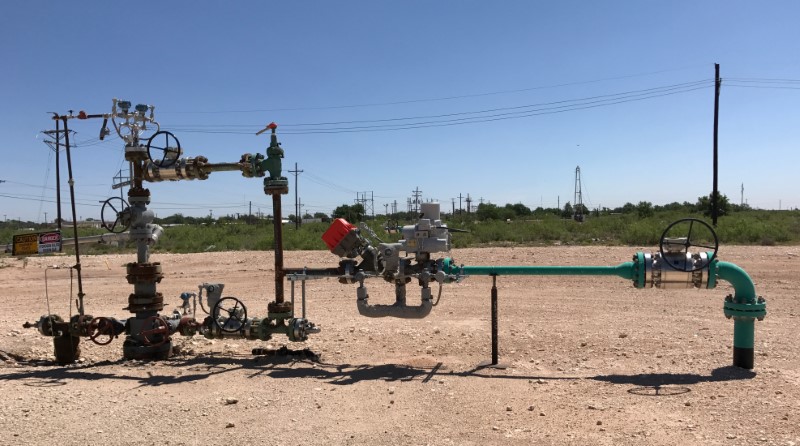
© Reuters. A wellhead is seen at an Occidental Petroleum Corp carbon dioxide enhanced oil recovery project in Hobbs
"Sentiment has turned and I think we should be going up (in price). I don't think it's going to last, but the momentum at the moment is with the bulls," PVM Oil Associates strategist Tamas Varga said.
The drop in U.S. rig count and U.S. Energy Information Administration figures showing output fell by 24,000 barrels per day (bpd) on a monthly basis "sent out a short-term bullish message," he said.
The oil price is still down 14 percent so far this year, as strong global demand has not been enough to absorb rising output from the United States, Nigeria, Libya and other locations, such as the Brazil and the North Sea.
Despite the dip in U.S. drilling, the total rig count was still more than double the 341 rigs in the same week a year ago, according to energy services firm Baker Hughes Inc.
Oil markets remain oversupplied as output from the Organization of the Petroleum Exporting Countries hit a 2017 high.
June OPEC production was up by 280,000 bpd at 32.72 million bpd, according to a Reuters survey, despite the group's pledge to hold back output.
"To put that in context, that is nearly a quarter of the 1.2 million barrels (per day) OPEC agreed to cut," said Greg McKenna, chief market strategist at AxiTrader, adding the rise came from Nigeria and Libya, which are exempted from the cuts.
Last week, money managers added to their bets against a sustained rise in the oil price. U.S. data showed investors increased short holdings of crude futures and options to close at their highest in a year.